
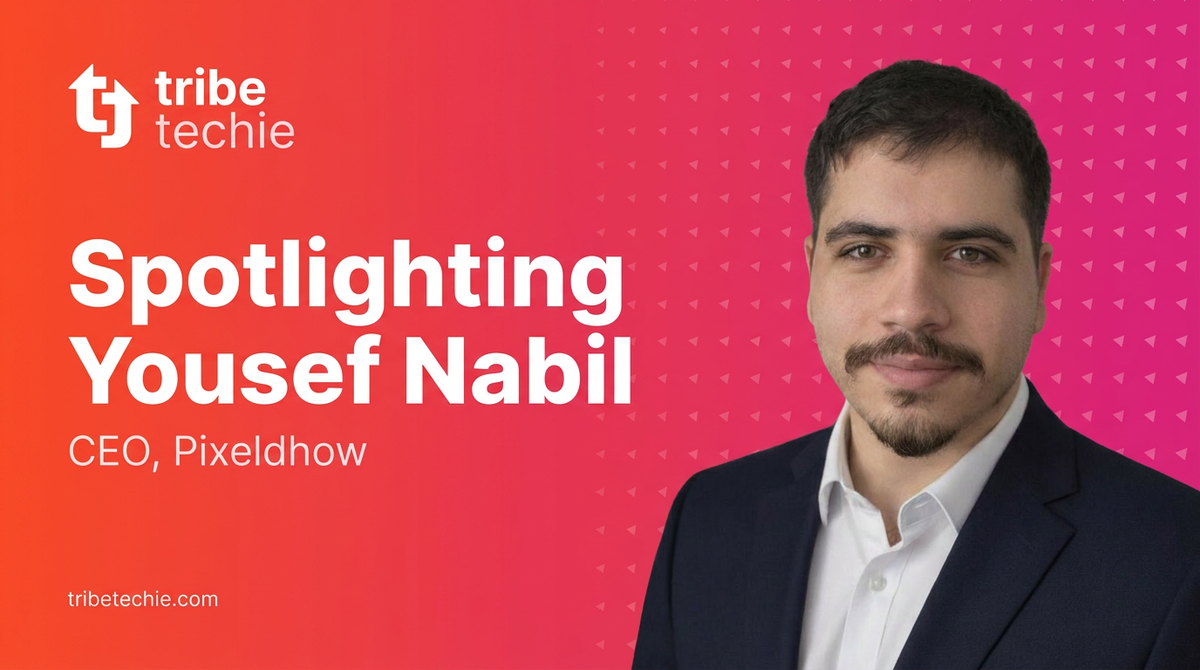
A simple question from a café owner in Doha set Yousef Nabil on an unexpected path. In today's Founders Series with Tribe Techie, the 23-year-old founder is building Pixeldhow, a Qatar-based startup combining bespoke digital experiences with multilingual voice AI to help businesses create more human online interactions.
Founder Snapshot
Founder: Yousef Nabil
Company: Pixeldhow
Sector: Artificial Intelligence (AI), SaaS & Digital Experience
Headquarters: Doha, Qatar
Founded: 2026
Stage: Early-stage (Bootstrapped)
What they do: Pixeldhow builds custom digital experiences and multilingual voice AI solutions that help businesses engage customers through more natural online interactions.
Most startup ideas begin with a founder spotting a gap in the market. Pixeldhow's began with a question.
While developing a website for Anana Café in Doha, founder Yousef Nabil was asked something that most digital agencies would probably have dismissed as an interesting idea rather than a business opportunity.
"Can the website actually talk to my customers and recommend drinks?"
For Nabil, the question lingered long after the meeting ended.
Instead of treating it as another client request, he began exploring what would happen if websites could do more than display information. What if they could greet visitors, understand questions, recommend products, and guide customers through a purchase the same way a salesperson would inside a physical store?
That single conversation became the foundation of Pixeldhow's next chapter.
Today, the Qatar-based startup is developing multilingual voice AI experiences designed to make websites feel less like static digital brochures and more like interactive conversations.
Building Beyond Templates
Before AI became Pixeldhow's defining ambition, the company started with a simpler mission.
Nabil had grown increasingly frustrated with what he saw across the digital agency landscape in Qatar and the wider Gulf.
Businesses were investing heavily in websites, yet many ended up with products built from the same templates, offering little distinction from competitors.
"I started Pixeldhow because I was frustrated with what I saw in the digital agency space," he said in conversations with Tribe Techie.
"Businesses were paying thousands for websites built on templates, getting the same generic design as everyone else."
Its name combines "Pixel" with "Dhow," the traditional Arabian sailing vessel, reflecting what Nabil describes as the intersection of modern technology and Gulf heritage. For him, every project should be intentionally crafted rather than assembled from pre-built components.
That thinking remains central to Pixeldhow's agency business, where the company develops custom websites, mobile applications, internal systems, CRM integrations and AI-powered digital experiences for businesses across Qatar.
Giving Websites a Voice
Go deeper on GCC & Africa tech — $9.99/month.
Deep dives and investor insights the free digest doesn't cover.
The café project, however, revealed a larger opportunity.
Instead of embedding a conventional chatbot, Pixeldhow developed Ayni, a multilingual voice AI host capable of greeting visitors, answering questions and recommending menu items in Arabic and English.
According to Nabil, the experience demonstrated that conversational AI could become more than a customer support feature. It could become the storefront itself.
That insight is now driving Pixeldhow's biggest product ambition: a self-service SaaS platform that enables merchants to deploy AI-powered voice sales agents across platforms including Shopify, WooCommerce, Salla, Zid, WordPress and Wix.
Unlike many website chatbots that remain confined to a small chat window, Nabil says Pixeldhow's technology is designed to actively guide visitors through websites by highlighting products, navigating pages and supporting customers throughout their buying journey.
The company says its voice AI supports more than 100 languages, including Gulf and Egyptian Arabic.
Bootstrapping an AI Startup in Qatar
Building advanced AI products without external funding is rarely straightforward.
Pixeldhow remains bootstrapped, with agency projects funding product development while Nabil balances entrepreneurship alongside a full-time role as an IT and Digital Coordinator at Seashore Group.
Maintaining engineering quality with a lean team has become one of the company's biggest challenges. "The technical challenge of making a voice AI assistant that actually controls a website is genuinely hard," Nabil noted.
He says Pixeldhow built its page-control engine from scratch after finding that existing frameworks couldn't deliver the interactive experience the company envisioned.
Operating from Qatar has also presented its own realities. While the country's startup ecosystem continues to expand, access to specialised AI talent and investors familiar with enterprise AI software remains more limited than in larger global technology hubs.
Yet Nabil believes building locally is also an advantage. By working closely with businesses across the Gulf, Pixeldhow has been able to design products around regional languages, customer behaviour and business needs rather than adapting solutions built elsewhere.
Looking Beyond Agency Services
Although Pixeldhow continues to operate as a digital agency, Nabil sees its future increasingly centred on software.
The long-term goal is to become what he describes as the voice AI infrastructure layer for online businesses, enabling merchants to deploy conversational sales assistants without writing code.
The company is currently applying to programmes including the Startup Qatar Investment Program and Hub71 Access Programme as it seeks support for the next stage of product development.
For Nabil, however, the vision extends beyond AI itself. "We believe every digital experience should feel like someone is there, paying attention," he said.
As conversational AI continues to reshape how businesses interact with customers, Pixeldhow is betting that the future of websites may not simply be faster or smarterbut considerably more human.
Editor's note: This profile is based on information provided by the founder and publicly available sources. Claims relating to company metrics, partnerships and future plans are attributed to the founder unless otherwise stated.
Engagement