

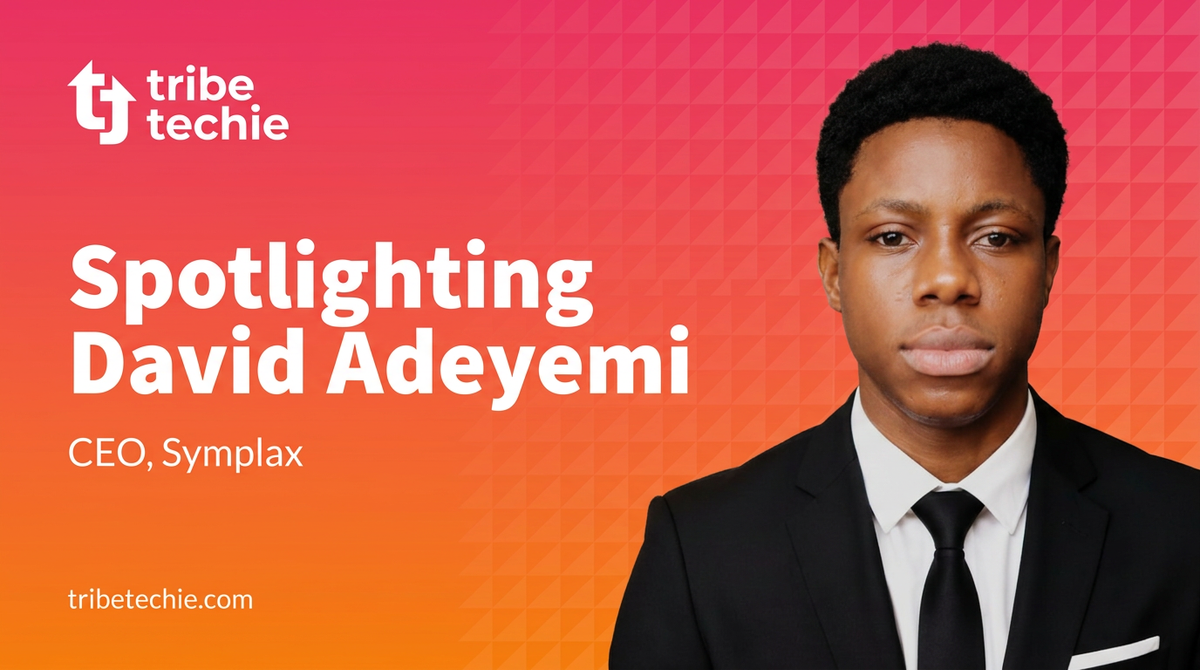
When a client's application crashed and remained down for days without his knowledge, Adeyemi David Adejuwon realised that managing servers did not have to be this difficult. That experience inspired Symplax, a Lagos-built startup helping developers manage infrastructure without giving up control.
Founder Snapshot
Founder: Adeyemi David Adejuwon
Company: Symplax
Sector: SaaS
Country: Nigeria
Founded: 2026
Stage: Early stage
What it does: Symplax helps developers manage and deploy applications on VPS infrastructure, while reducing the DevOps complexity traditionally involved in running their own servers.
Startup Playbook: 10 Guides Every Founder Should Read
A client's server had been down for days. David Adeyemi did not know. On the surface, everything appeared fine. The landing page was still live, giving no obvious indication that anything had gone wrong. But somewhere behind it, the application itself had silently crashed. He only discovered the problem when the client called.
For the Lagos-based developer, it was a particularly frustrating reminder of the reality of managing servers. As a freelance developer handling client infrastructure, he had become accustomed to SSH-ing into servers late at night, restarting crashed processes and spending long stretches diagnosing problems that, in his view, should have taken minutes to fix.
That moment made him realise that developers like him needed something different, more like a tool that watches the server so you don't have to. And this became the starting point for Symplax, an early-stage SaaS startup launched in 2026 to simplify server management for developers, particularly those who want to maintain ownership and control of their infrastructure without taking on the full burden of DevOps.
The Server Failure That Started It All
For many developers, deploying an application is only the beginning. Managing the infrastructure behind it can involve configuring security, maintaining databases, monitoring applications, troubleshooting failures and repeatedly returning to the terminal when something breaks. Developers who want convenience can turn to managed platforms, but that often means handing over greater control of their infrastructure.
On the other hand, those who choose to run and manage their own VPS servers retain control but inherit more operational work. Adeyemi found himself living somewhere in that gap.
"I would SSH into servers at 2 a.m. to restart a crashed process, spend 45 minutes diagnosing what should have been a two-minute fix, and bill clients for time I spent fighting infrastructure instead of building," he said.
Symplax was built around the idea that developers should not have to choose so sharply between convenience and infrastructure ownership.
The platform is designed to give developers a simpler way to manage their servers while allowing them to retain control over the infrastructure running their applications. Its focus on local-currency pricing is also part of the company's broader ambition to build around the realities of African developers and software businesses.
How Symplax Is Rethinking Server Management
Adeyemi initially built Symplax for developers who already had a VPS and needed an easier way to manage it. But soon after launch, the product revealed a problem he had not anticipated.
Within two weeks of launching Symplax in July 2026, the startup recorded 55 signups without paid marketing. At first, it looked like an encouraging start, but then he noticed nobody was connecting a server. Rather than guessing why, he added a simple onboarding question: "Do you have a VPS?"
According to him, every respondent answered no, meaning the problem was not that developers were unwilling to use Symplax, but they did not yet have the infrastructure which the original product expected them to bring.
It was an early lesson in listening to users. Instead of waiting months to rethink the product, the young developer simply changed Symplax's direction and began building VPS provisioning directly into the platform. The new feature would allow users to create and manage a server from within the Symplax dashboard, with pricing starting from ₦20 per hour.
Go deeper on GCC & Africa tech — $9.99/month.
Deep dives and investor insights the free digest doesn't cover.
The insight was simple: if the first barrier to using the product was getting a server, Symplax needed to help users solve that problem too.
55 Signups Later, Symplax Had a Bigger Problem
For an early-stage founder, 55 signups might have been enough reason to celebrate. But the lack of activation turned out to be more valuable than the signups themselves.
It forced him to look beyond the headline number and ask what users were actually doing, a distinction that shaped one of the most significant product decisions Symplax has made so far. In less than a month, Adeyemi built and shipped VPS provisioning as a solo founder.
The feature involved integrating with Hetzner's API, building a wallet and billing system with hourly deductions, creating automated server-hardening processes and supporting both pay-as-you-go and monthly billing. He also added Flutterwave payment integration, rescue-mode recovery and support for sudo users.
It was, he said, the hardest thing he had done since starting the company. But the real milestone came afterwards. "When the first user connected a server provisioned through Symplax and their app went live, that was the moment I knew the product was real," he said.
Building the Missing Piece Alone
Symplax has been built entirely in Lagos by Adejuwon, a 22-year-old self-taught developer working a full-time job alongside the startup. Every line of code, product decision and marketing post, he said, has so far been handled by one person.
The company has already exhibited at the NITHUB Innovation Fair 2026 at the University of Lagos and has applied to programmes including YC Fall 2026 and the iDICE Growth Lab 2026.
For now, however, the focus remains on building. Symplax is live with a free plan that does not require a credit card, while users can also provision and manage servers directly from the platform.
The startup's early journey reflects a reality familiar to many African founders: building a product is one challenge; building around the infrastructure, payments and workflows needed to make that product usable in local markets is another. Adeyemi is betting that solving those practical problems could become part of Symplax's advantage.
Future Ambition for African Developers
The vision is considerably bigger than helping one developer avoid another late-night server emergency.
Adeyemi wants Symplax to become the infrastructure layer for African software companies, serving developers and teams across Nigeria, Ghana, East Africa and beyond.
"In three years, I want Symplax to be what Vercel is to frontend developers, but for the entire African backend ecosystem," he said.
The company hopes to give developers infrastructure they can own and control, paired with tools and pricing designed around their workflows and local markets. It is an ambitious goal for a startup launched only months ago, but one we believe is entirely achievable and surpassable.
If Symplax succeeds, the company will be built on a lesson its founder learned the hard way: sometimes, the most important problem in infrastructure is the one nobody notices until something breaks.
Engagement