
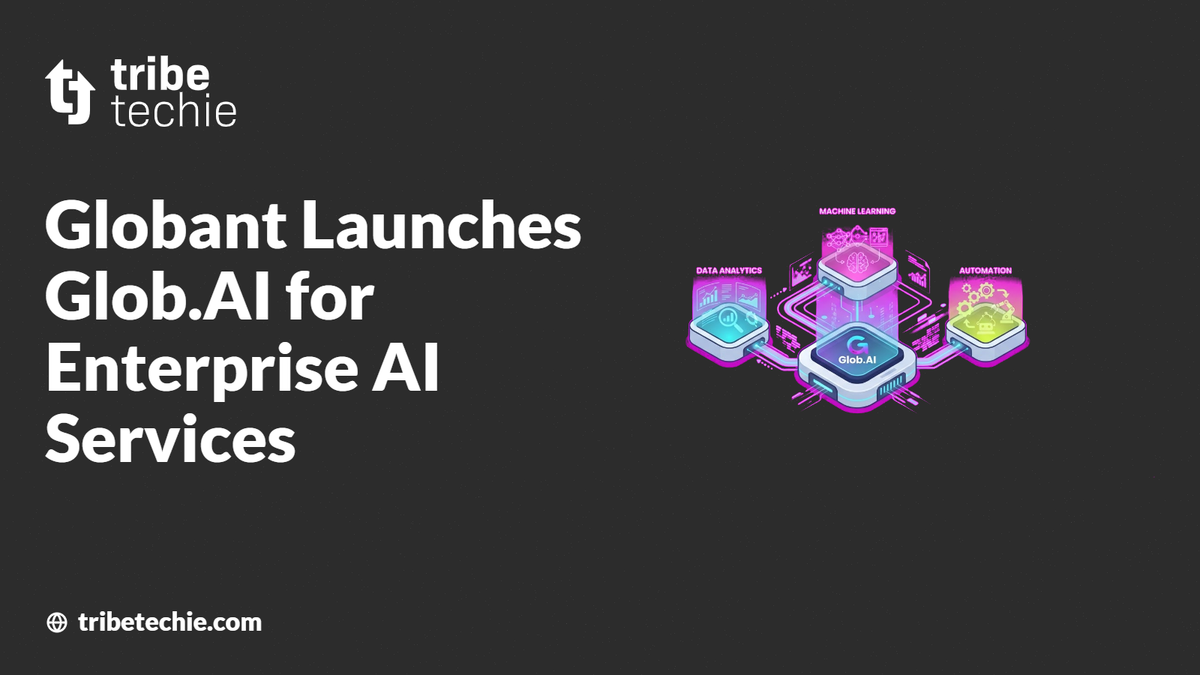
Globant has officially launched Glob.AI, an AI-native platform designed to deliver enterprise AI services through a self-service, pay-for-output model. This platform introduces a new way for businesses to leverage technology by moving away from traditional billing.
The platform is built around AI Pods, which are specialized service units powered by multiple AI agents and supervised by human experts. Instead of paying for seats or consulting hours, customers pay based on the outputs produced or the specific AI services they consume.
Also Read: Majestic Mind Games Raises $1.45M for Global Expansion
The launch represents a shift from traditional enterprise technology delivery. Most projects currently involve lengthy discovery phases, RFPs, procurement processes, and fixed development engagements, rather than this continuous and consumption-based model.
How Glob.AI Transforms Enterprise AI Services
Glob.AI is designed to combine autonomous AI agents with Globant’s enterprise technology expertise and governance processes. According to the company, AI Pods can execute defined workflows using parallel agents, automated loops, structured processes, and deterministic workflows, while Globant specialists supervise the outputs and guide the process.
The platform is built around repeatable and documented processes intended to meet enterprise requirements for security, quality, governance, and scalability. Globant CEO and co-founder Martín Migoya said the platform represents the company’s next step in applying AI to enterprise technology services.
“Glob.AI is our next step: the one-stop shop where our AI Pods live, each specialized by task and industry,” Migoya said. He added that the model is designed to reduce inefficient AI usage and the manual supervision associated with enterprise AI adoption.
Pricing and Efficiency Models
One of Glob.AI’s key differentiators is its pricing model. Rather than charging customers based on the number of users, employees, or hours worked, the platform charges for validated outputs and actual consumption.
Globant says the model is designed to eliminate costs associated with idle capacity, AI retries, hallucinations, and unnecessary token consumption. The company claims that its AI Pods can deliver at least 30% greater productivity than a conventional engineer-plus-AI approach.
Glob.AI also incorporates what Globant describes as AI sovereignty and governance. This gives customers flexibility over which AI models they use and where those models run, ensuring client data is not used to train external models.
Token consumption is managed through a proprietary Token Vault. This provides visibility into AI usage while allowing organisations to build an accumulating repository of institutional knowledge.
AI Pods Target Enterprise Use Cases
Organizations joining the Glob.AI waiting list will receive early access to a catalogue of AI-powered workflows designed for enterprise software development and specialised industry applications.
Go deeper on GCC & Africa tech — $9.99/month.
Deep dives and investor insights the free digest doesn't cover.
The platform includes AI Pods supported through partnerships with major technology companies, including Anthropic, AWS, Vercel, OpenAI, Adobe, Microsoft Azure, Google Cloud, SAP, and Salesforce.
Globant first introduced its AI Pods in mid-2025. The company says they are already being used by several Fortune 500 organisations across sectors, including media, entertainment, professional services, and financial services.
Guibert Englebienne, co-founder of Globant, said AI is expanding the range of technology projects that businesses can economically pursue. “AI is not just making the same projects faster; it is making thousands of projects viable that never were before,” Englebienne said.
From Project-Based Delivery to Continuous Services
The launch also reflects a broader change in the enterprise software market. Traditional technology services often require organisations to define a project, issue an RFP, select a provider, negotiate a contract, and wait for development to begin.
Glob.AI instead positions technology delivery as an always-on service that companies can access through the platform. Customers can begin building enterprise software directly through the platform, while improvements and releases can be delivered continuously and monitored by clients in real time.
If the model gains traction, it could change how businesses budget for technology services. The shift would move spending from developer capacity and project timelines to measurable outputs and ongoing AI-powered delivery.
Why it Matters to MENA
Glob.AI’s launch is particularly relevant to MENA as enterprises across the region accelerate AI adoption and look for ways to move from experimentation to production.
Financial institutions, governments, telecom companies, retailers, logistics businesses, and large enterprises across the Gulf are investing heavily in AI. However, deploying AI at scale requires more than access to foundation models; organisations also need governance, cybersecurity, data controls, skilled oversight, and reliable processes.
An output-based model could therefore appeal to MENA enterprises looking for greater predictability in AI spending and faster access to specialised technology services. The platform’s emphasis on AI sovereignty and governance is also significant for organisations operating in highly regulated sectors.
Giving enterprises greater control over models, deployment environments, data, and AI usage could become increasingly important as regional governments strengthen AI governance and data regulations. There is also a potential opportunity for MENA’s growing technology-services ecosystem.
As enterprises seek to integrate AI into existing systems rather than build everything from scratch, AI-native service platforms could increasingly compete with traditional consulting and software-development models. For the region, the bigger takeaway is that the AI services market may be moving toward a results-based economy.
Instead of asking how many developers or AI tools an organisation needs, enterprises could increasingly ask how much measurable work AI can deliver. Globant is betting that AI Pods can become part of that transition by combining autonomous agents, human oversight, enterprise governance, and consumption-based pricing in a single model.
Engagement