
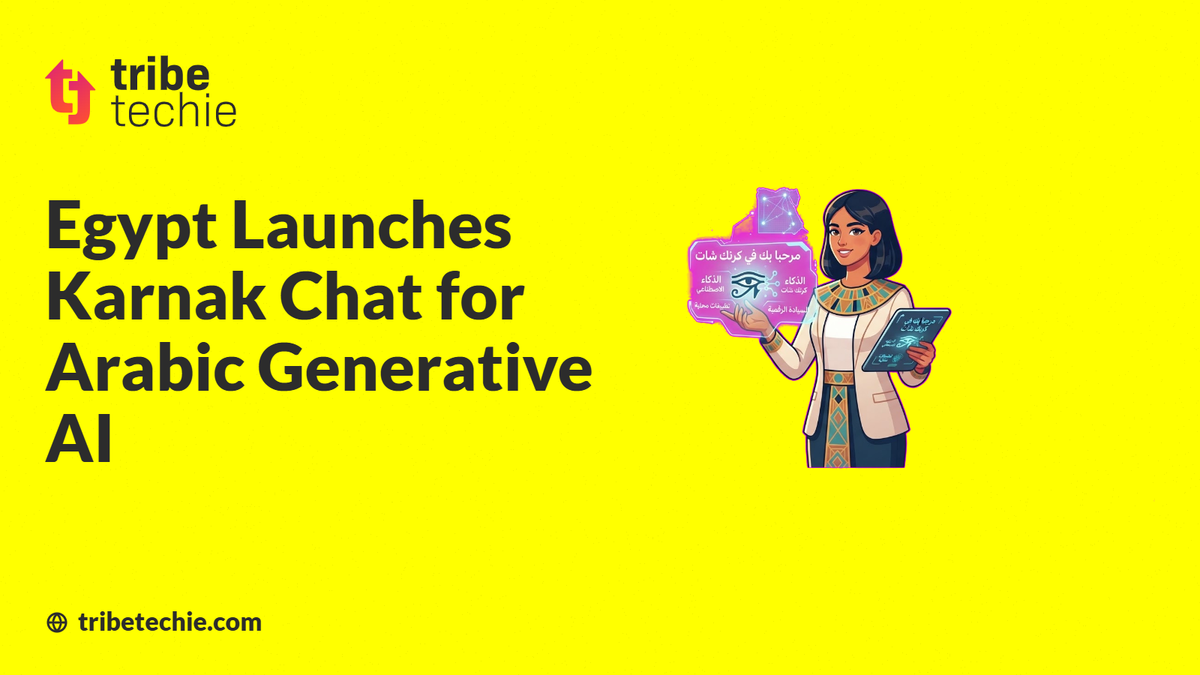
Egypt launches Karnak Chat, an Arabic generative AI platform designed to support digital sovereignty and locally developed AI applications. The initiative focuses on developing AI systems that better understand Egypt’s linguistic and cultural context while providing a foundation for building generative AI applications for organizations across Egypt and the wider Arab world.
Also Read: Cyfr Capital Backs 5 Omani Startups in New Seed Deals
Understanding Karnak Chat Capabilities
Karnak is designed to understand and generate both Modern Standard Arabic and Egyptian colloquial Arabic, with a focus on improving the accuracy and relevance of AI-generated responses for Arabic-speaking users.
The model was developed by enhancing the capabilities of the latest global open-source AI models. Its development involved the curation of a large collection of data and documents published in Egypt and across the Arab world.
This approach is intended to give Karnak a stronger understanding of regional language, knowledge and cultural context than general-purpose models that may have limited exposure to Arabic-language and locally relevant data.
The chatbot is also designed to draw on verified and reliable information while taking Egyptian and broader Arab cultural considerations into account.
Strengthening Digital Sovereignty
A key objective of the project is to strengthen Egypt’s digital sovereignty by giving organizations greater control over how AI systems are deployed and where their data is processed.
Karnak’s software and applications built on the model can be operated within local data centres where required. This could be particularly relevant for government institutions, enterprises and other organizations handling sensitive information or operating under local data and security requirements.
Local deployment also reduces dependence on overseas infrastructure for organizations seeking to integrate generative AI into their operations.
Building an Arabic AI Ecosystem
Karnak is positioned as more than a consumer-facing chatbot. The underlying large language model is intended to serve as a foundation for developers and organizations building their own generative AI applications.
Go deeper on GCC & Africa tech — $9.99/month.
Deep dives and investor insights the free digest doesn't cover.
This could enable the development of sector-specific solutions across areas such as government services, education, business and other parts of the economy.
By making Arabic language capabilities and regional context central to the model, the project aims to contribute to a broader generative AI ecosystem in Egypt and the Arab world.
The approach also reflects a wider shift among governments and technology ecosystems in the region toward developing locally relevant AI infrastructure rather than relying exclusively on models and computing infrastructure developed elsewhere.
Strategic Impact for the Region
The launch comes as countries across the Middle East and North Africa increasingly view AI as a strategic technology for economic development, public services and digital transformation.
For Egypt, Karnak provides an opportunity to build domestic capabilities around Arabic AI while supporting developers and organizations seeking to create applications tailored to regional needs.
Its ability to operate in local data centres could further strengthen its relevance for institutions where data residency and digital sovereignty are priorities.
As the platform develops, the expansion of its underlying model and applications could determine how effectively Karnak moves from a pilot initiative into a broader piece of Egypt’s AI infrastructure.
Why it matters to MENA
Arabic AI is becoming a strategic technology layer for the region. Karnak’s focus on both Modern Standard Arabic and Egyptian Arabic, combined with local deployment capabilities, addresses two important challenges: linguistic relevance and control over AI infrastructure.
If the platform scales successfully, it could provide Egyptian developers and organizations with a locally relevant foundation for building AI applications while contributing to the wider development of Arabic-first generative AI across MENA.
Engagement