

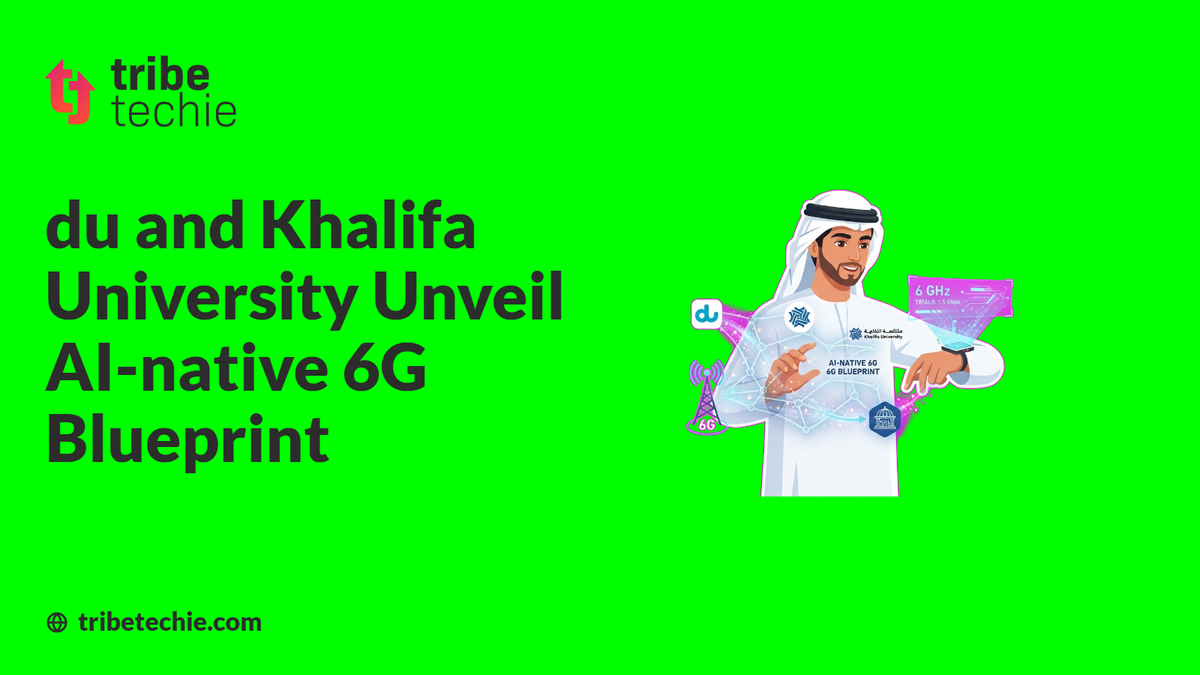
UAE telecom operator du and Khalifa University have officially unveiled an AI-native 6G blueprint as du reports successful 6 GHz trials reaching speeds near 1.5 Gbps.
The blueprint is presented in du’s first industry whitepaper, The Intelligence Network: A 6G Blueprint for Telcos, developed by du Infra in collaboration with the Digital Future Institute at Khalifa University.
Also Read: UMAMI Launches $1M AI Learning Platform for MENA
The publication explores how telecom operators can build networks that use artificial intelligence to sense, predict, make decisions, and act in real time, while creating new commercial opportunities from network intelligence.
Unlike traditional networks that primarily provide connectivity, the blueprint envisions 6G as an AI-native, software-defined infrastructure layer capable of operating with greater autonomy.
The Future of AI-native 6G Networks
Key technologies highlighted in the whitepaper include intent-based orchestration, Network Digital Twins, and Telecom World Models. Together, these technologies could enable networks to understand changing conditions, predict demand, optimise resources, and automatically adjust operations.
The blueprint also identifies the Radio Access Network (RAN) as a potential centre of network intelligence. Under this model, the RAN would move beyond its traditional role of transmitting wireless signals to become a more intelligent, energy-efficient and sensing-enabled component of the telecommunications ecosystem.
The shift is becoming increasingly important as data consumption continues to rise while telecom operators face pressure to generate stronger returns from network investments. The whitepaper cites industry projections that mobile data traffic could more than triple by 2030, while telecom revenues are expected to grow at a considerably slower pace.
Testing Next-Generation Connectivity
du is also using its existing network infrastructure to test the technologies and spectrum capabilities that could support next-generation connectivity. The operator's upper 6 GHz field trials were conducted on live macro infrastructure in Mohamed Bin Zayed City, Abu Dhabi.
According to du, the trials achieved outdoor coverage of up to 500 metres and peak downlink speeds approaching 1.5 Gbps using existing site infrastructure. The results provide an early indication of how upper-mid-band spectrum could be deployed at scale while leveraging existing telecom infrastructure.
Go deeper on GCC & Africa tech — $9.99/month.
Deep dives and investor insights the free digest doesn't cover.
For du, the trials also demonstrate that the development of next-generation networks does not have to be separated from the evolution of current infrastructure.
Commercializing Network Intelligence
Fahad Al Hassawi, CEO of du, said the next decade of telecommunications would be shaped by the amount of intelligence networks can deliver. “The next decade of telecom will be defined by how much intelligence they can deliver,” Al Hassawi said, noting the transition toward AI-native infrastructure is already underway.
The commercial opportunity outlined in the blueprint extends beyond faster mobile connectivity. du believes AI-native networks could allow telecom operators to package network intelligence into new services for enterprises and other customers.
Potential opportunities identified in the whitepaper include AI-powered network operations, enterprise digital twins, autonomous AI agents, and outcome-based service guarantees. This could create new revenue streams while allowing operators to move beyond the traditional model of monetising connectivity alone.
Collaboration and Regional Impact
The strategy builds on du’s existing 5G-Advanced infrastructure and its commitment under the TM Forum Autonomous Networks Manifesto. The partnership with Khalifa University is also significant because it combines academic research with live telecom deployment.
H.E. Professor Ebrahim Al Hajri, President of Khalifa University, said collaboration between academia and industry is essential to translating research into practical solutions for intelligent telecommunications. He added that the partnership supports the UAE’s ambitions around advanced technology and knowledge-driven economic growth.
Why it matters to MENA
du and Khalifa University's 6G initiative matters beyond the UAE because the next generation of telecom infrastructure will increasingly be an AI infrastructure story.
MENA countries are investing heavily in smart cities, autonomous systems, cloud computing, AI, connected infrastructure and digital government. These applications will require networks that can do more than move data—they will need to dynamically understand traffic, optimise resources, support real-time sensing and respond to changing conditions.
For the region's telecom sector, the race for 6G will not simply be about faster speeds, but about building networks that can think, adapt and generate new forms of value. du's blueprint positions the UAE as an early participant in that transition, combining 6G research, AI, spectrum trials and commercial network strategy into a roadmap for the next generation of telecommunications.
Engagement