
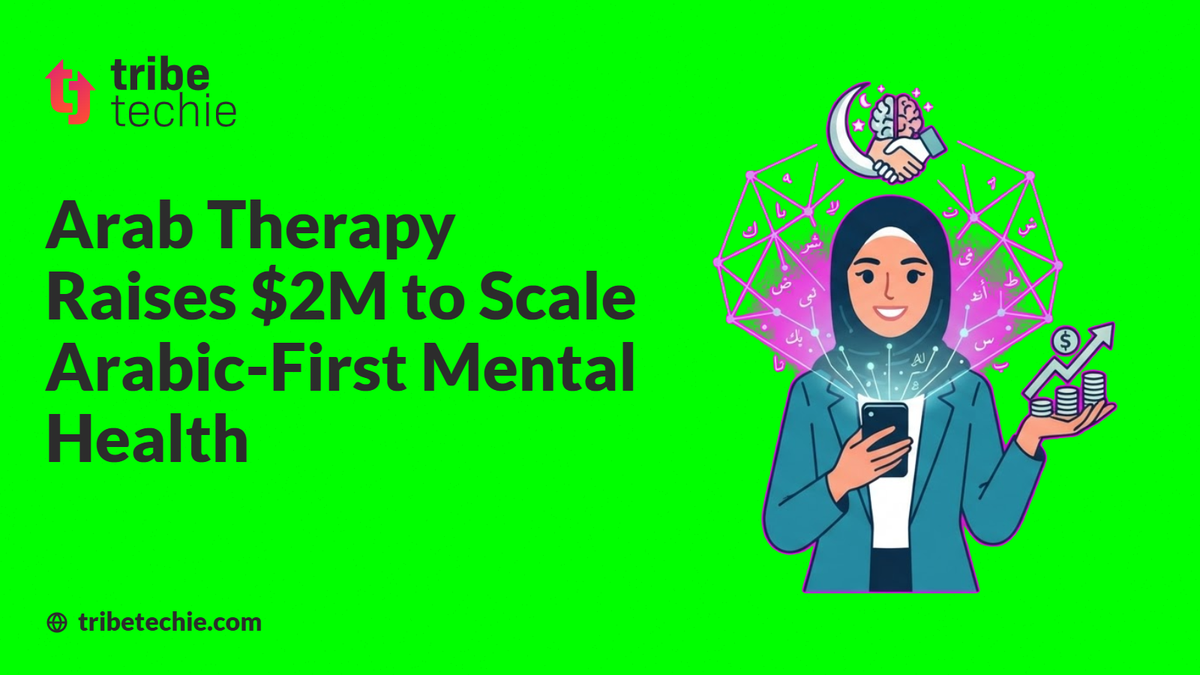
Arab Therapy has raised $2M in Pre-Series A funding to scale its Arabic mental health platform, which provides AI-driven resources across Saudi Arabia and the MENA region.
The round was led by Jordan-based Manara Ventures, with participation from Anara Impact Fund and Saudi Arabia-based Value Makers Studio (VMS).
Also Read: Cybastion Expands Digital Skills Training Across Africa
Founded in Berlin by Jordanian entrepreneurs Dr. Tareq Dalbah, CEO and Co-Founder, and Hekmat Al Hasi, CPTO and Co-Founder, Arab Therapy currently operates across Saudi Arabia, Jordan, Germany, and Egypt.
The company plans to use the new capital to expand its regional footprint, scale its AI-powered platform, and increase access to personalised healthcare for individuals and organisations.
Scaling Arabic Mental Health Solutions
Arab Therapy combines digital mental health content, AI-powered tools, and online therapy delivered by licensed specialists. Its clinical framework is supervised by certified professionals affiliated with the University of Hamburg in Germany.
The platform serves both individual users and organisations through two business models. Its consumer platform provides direct access to resources, while its enterprise offering helps organisations support employee wellbeing at scale.
The company's Arabic-first approach is central to its expansion strategy. While digital services have grown globally, many platforms are primarily designed around English-speaking users.
Arab Therapy is targeting the gap between the growing demand for support among Arabic-speaking populations and the limited availability of digital services designed around specific cultural contexts.
Market Expansion and Regional Growth
The latest funding will support Arab Therapy's expansion in Saudi Arabia and other markets, enabling the development of additional AI-powered products. Saudi Arabia remains a key market given the Kingdom's expanding digital health ecosystem.
Luma Fawaz, Managing Director of Manara Ventures, said the investment reflects the firm's belief in the ability of Jordanian founders to build companies capable of serving regional markets.
Go deeper on GCC & Africa tech — $9.99/month.
Deep dives and investor insights the free digest doesn't cover.
Nadia Moukaddam, Principal at Anara Impact Fund, described the company as an effort to build infrastructure specifically for the Arab region. This highlights the importance of addressing cultural and linguistic barriers in digital healthcare.
Moataz Abuonoq, Founder and CEO of VMS, noted that the platform could expand access to care across the wider region and international markets. Arab Therapy is currently targeting a potential user base of more than 400 million Arabic speakers.
Overcoming Barriers to Care
Access to mental healthcare remains uneven across MENA, with challenges including shortages of specialists, affordability, stigma, and limited availability of services delivered in appropriate ways.
The World Health Organization has highlighted persistent gaps in mental health resources across the region. However, growing public awareness is contributing to greater discussion around professional support.
Digital platforms can help address these access barriers by allowing users to engage with resources remotely. AI adds another layer to this model by enabling personalized digital tools alongside human-led therapy.
The company's long-term opportunity will depend on maintaining appropriate clinical oversight as it scales services across different regulatory environments.
Why it matters to MENA
Arab Therapy's funding highlights a broader opportunity for healthtech in MENA. The region has a large, connected population, but much of the global digital health ecosystem has historically been built around English-language markets.
Developing products specifically for Arabic users creates opportunities that go beyond simple translation. Mental healthcare is sensitive to language and cultural context, as the way people describe emotional distress varies across communities.
An Arabic-first digital platform can reduce these barriers while giving users more familiar ways to access support. The enterprise side of the model is also significant.
As companies across the Gulf place greater emphasis on employee wellbeing, digital platforms could become a standard component of corporate healthcare programs.
Engagement