

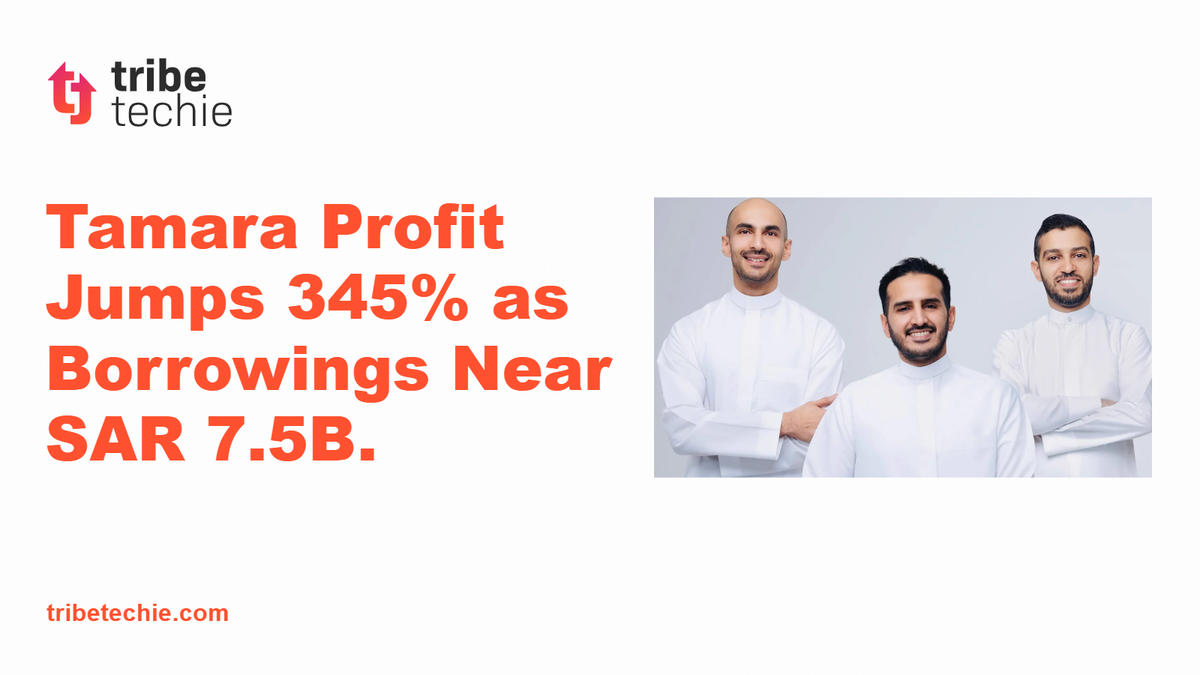
Tamara has seen a major financial shift, with Tamara profit rising 345% to SAR 411M as borrowings reached SAR 7.5B and expected credit-loss charges climbed sharply.
The Saudi buy now, pay later (BNPL) company reported net profit of SAR 411.02 million for the first nine months of 2026, up 345% from SAR 92.39 million a year earlier. At the same time, its borrowings nearly doubled to SAR 7.52 billion, while the charge for expected credit losses climbed almost eightfold.
Also Read: Foodics Invests in Funding Souq for Restaurant Financing
The figures reveal two sides of Tamara's growth: a more profitable lending business and a much larger financing operation carrying higher funding costs and credit risk.
Understanding Tamara Profit and Growth Trends
According to its third-quarter financial statements, Q3 net profit reached SAR 203.63 million, compared with SAR 28.08 million in the same period last year. It was also up 142% from SAR 84.04 million in Q2.
Tamara's total revenue rose to SAR 2.26 billion in the first nine months of 2026, compared with SAR 829.09 million a year earlier. Merchant network revenue, which includes income from the company's relationships with merchants, increased 109% to SAR 1.37 billion.
Profit from Islamic financing also climbed sharply, reaching SAR 713.92 million from SAR 30.92 million in the same period last year. The expansion of Islamic financing is particularly significant. The product has become a major part of Tamara's lending business, with its receivables reaching SAR 4.37 billion by September 30.
That growth is reflected in the wider consumer lending portfolio. Gross consumer receivables more than doubled to SAR 8.68 billion, from SAR 4.18 billion at the end of 2025.
In other words, Tamara is not simply processing more instalment purchases. It is building a considerably larger consumer financing book, with longer-term Islamic financing now contributing substantially to its income.
Financing the Lending Operations
Where is the money coming from? Tamara relies heavily on asset-backed financing. In September 2025, the company announced a Shariah-compliant facility of up to USD 2.4 billion backed by Goldman Sachs, Citi and funds managed by Apollo.
The arrangement refinanced and expanded an earlier USD 500 million facility. Its initial amount was USD 1.4 billion, with a further USD 1 billion available subject to approvals. The structure allows Tamara to raise financing against eligible consumer receivables — the payments customers owe the company.
Its latest financial statements show borrowings of SAR 7.52 billion at September 30, 2026, compared with SAR 3.76 billion at the end of 2025. The company's funding costs also rose to SAR 316.77 million from SAR 152.43 million in the first nine months of 2025.
This is not the same as a startup taking an ordinary business loan to cover operating expenses. Tamara uses a Shariah-compliant securitization structure involving senior financing and mezzanine Murabaha. Its receivables secure the funding, while customer collections help service the financing.
Go deeper on GCC & Africa tech — $9.99/month.
Deep dives and investor insights the free digest doesn't cover.
The scale is worth noting: all SAR 7.50 billion of the facility commitments disclosed in the September statements had been utilized, leaving no unused commitment at that reporting date.
Analyzing Credit Losses and Risk
The bigger question is what happens when a larger lending portfolio comes with more customers who cannot repay as expected. Tamara recorded a net expected credit loss allowance charge of SAR 553.03 million for the first nine months of 2026, compared with SAR 70.35 million a year earlier. That is an increase of approximately 686%.
Expected credit losses estimate the money a lender may not recover from its financing portfolio. They are recognized as an expense, but they do not mean that every amount provided for has already become an actual default.
There is more to the figures, however. Tamara's statements show a gross impairment charge of SAR 740.77 million, partly offset by SAR 187.75 million recovered from previously written-off balances. The company also reported SAR 435.74 million in consumer receivables written off during the nine months.
The closing expected-credit-loss allowance stood at SAR 249.43 million, compared with SAR 132.14 million at the end of 2025. Tamara says it will continue pursuing recovery of the written-off balances.
These figures deserve attention because the credit-loss charge has grown much faster than the gross receivables portfolio, which increased by about 108% between December 2025 and September 2026.
Still, the numbers alone do not establish why the charge increased. A larger portfolio, changes in the mix and age of loans, and deterioration in repayment performance can all affect expected credit losses.
Strategic Context and Future Outlook
Tamara's financing strategy also needs context. The company announced its USD 2.4 billion asset-backed facility in September 2025, before the current regional conflict began in 2026. Its reliance on borrowing is therefore not a new response to the slowdown in equity funding.
Tamara's model illustrates another way a mature fintech can fund lending growth: raise money against the receivables it generates rather than depend entirely on selling equity.
The comparison with Tabby is interesting, although the two companies do not publish directly comparable profit figures. In September 2026, Tabby raised USD 233 million at a USD 6.5 billion valuation. The company says it has been profitable since 2023, but it did not disclose an equivalent net income figure in that announcement.
Tamara's last publicly announced equity round was its USD 340 million Series C in December 2023, which valued the company at USD 1 billion. Since then, its funding announcements have also included substantial asset-backed financing.
Tamara's next results should help answer three questions: Credit quality, funding costs, and regulation. Tamara has shown that its lending business can generate substantial profit at scale. The next test is whether it can maintain that profitability while controlling credit losses and the cost of financing the loans behind it.
Engagement