
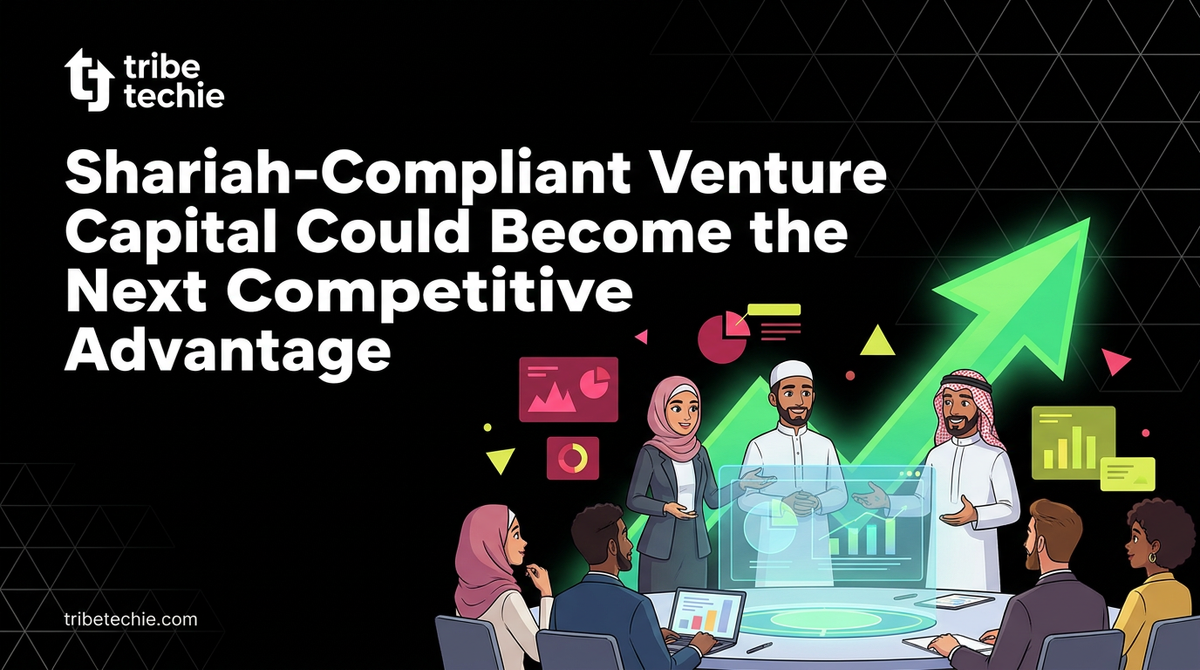
Silicon Valley's venture capital model helped shape the GCC's startup ecosystem. But for Muslim founders seeking shariah-compliant financing, some of its most common investment structures can create an invisible barrier. As Islamic finance and venture capital continue to converge, a new opportunity is emerging for founders and investors alike.
Opinion | Adapted by Tribe Techie from Maryam Garba-Sani's original research
This article was first published in Islamic Finance News (IFN).
Imagine walking away from one of the region's most respected startup accelerators because accepting the investment would require you to use a financing structure that conflicts with your religious principles.
This is the starting point for a wider question explored in Maryam Garba-Sani's original research into Shariah-compliant venture financing: can Muslim founders raise venture capital without compromising their values?
At first glance, the tension may seem surprising. Major startup ecosystems across Saudi Arabia, the UAE, Qatar, Egypt and other GCC markets operate within predominantly Muslim societies. These markets have spent the past decade attracting accelerators, international venture funds and ambitious entrepreneurs.
Yet the financing structures used to fund these businesses have often been developed elsewhere.
For years, GCC’s startup ecosystem has borrowed heavily from Silicon Valley's venture capital playbook. Accelerators, investment documents, fundraising instruments and legal agreements have largely been imported from mature Western markets because they are familiar, scalable and widely accepted by global investors.
Following that standardisation has helped accelerate ecosystem growth and has also created blind spots.
Some of the financial instruments now considered standard practice in venture capital were not designed around Islamic commercial principles. Founders seeking Shariah-compliant funding can therefore find themselves adapting to systems that were never designed with their requirements in mind.
Ironically, the underlying philosophy of venture capital can overlap with several principles of Islamic finance. Venture capital involves equity ownership, shared risk, long-term partnerships and investment in productive businesses.
The friction often emerges in the structures used to execute those investments and this changes the question. Instead of asking whether venture capital and Islamic finance are compatible, the more useful question may be:
How can venture capital evolve to better reflect the realities of the markets it serves?
Garba-Sani's research identifies four recurring gaps in the ecosystem: Instrument, Capital, Advisor and Narrative, or the I-CAN framework.
Instrument: Many startup financing tools were designed without Shariah considerations in mind.
Capital: Investors interested in faith-aligned venture investing often lack clear pathways into the asset class.
Advisor: There remains a shortage of specialists who understand both Islamic jurisprudence and startup finance.
Narrative: Simplified assumptions about the GCC can overlook the diversity of its markets and founders.
Together, these gaps help explain why Shariah-compliant venture capital remains difficult to access, while also pointing towards opportunities to build a more context-aware investment ecosystem.
Gap 1: The Rules of Fundraising Don't Fit the Market
If venture capital can broadly align with some principles of Islamic finance, why does fundraising still create friction?
The answer often comes down to the investment instrument.
In venture capital, an instrument is the legal mechanism through which an investment is made. It determines how investors provide capital, when they receive equity and what happens as a company develops.
Today, one of the most widely used early-stage instruments is the Simple Agreement for Future Equity (SAFE).
Introduced by Y Combinator in 2013, the SAFE became popular because it allowed startups to raise money without immediately negotiating a full company valuation. Investors provide capital in exchange for the right to receive equity later, usually following a future financing event.
For founders, SAFEs can make fundraising faster and less expensive. For investors, they simplify deal execution. But their structure has also prompted debate among Islamic finance scholars. One concern is uncertainty, or gharar.
Under a typical SAFE, an investor provides capital today while the exact equity they will receive is determined by a future event. At the point of signing, neither side necessarily knows the precise number of shares that will ultimately be issued or the valuation at which the investment will convert.
Conventional venture capital accepts this uncertainty as part of early-stage investing. Islamic commercial law, however, generally places greater emphasis on clarity around contractual rights and obligations.
The question, therefore, is not simply whether SAFEs are permissible or impermissible. Rather, it concerns whether the level and nature of uncertainty involved crosses the threshold of what is acceptable under Shariah principles.
Risk allocation is another point of discussion.
Garba-Sani's research highlights concerns around provisions that can allow investors to recover their original investment or the value of their shares if a startup is acquired before a SAFE converts. Critics argue that such provisions can create an imbalance in how risk and reward are shared.
For founders, these questions are not academic. One founder cited in the research declined participation in a leading accelerator because of its requirement to use a conventional SAFE. Another entrepreneur responded by building a Shariah-compliant venture debt company aimed at addressing the financing gap.
The ecosystem had capital available. The challenge was finding a structure that worked for both the investor and the founder.
The Search for Better Alternatives
The conversation is already moving beyond the problem. Across markets, investors, legal advisers and Islamic finance specialists are exploring ways to adapt existing venture structures rather than abandoning them.
Some are modifying SAFE agreements, removing provisions that create concerns while exploring structures based on established Islamic partnership models such as musharaka. Others favour traditional priced equity rounds, while specialist investment firms are developing Shariah-compliant financing documents from the ground up.
Each approach comes with trade-offs. A founder may successfully negotiate a Shariah-compliant agreement with one investor, but complications can arise when other investors on the same cap table operate under different contractual frameworks.
This means the challenge extends beyond a single investment contract. It concerns the architecture of the wider investment ecosystem.
For founders, the implication is straightforward: understanding an investor's capital is increasingly only part of the fundraising conversation. Understanding how that capital is structured can matter just as much.
Gap 2: Capital Exists, But Shariah-Compliant Access Doesn't
It is easy to assume that the Shariah-compliant venture capital gap exists because there is not enough money. The reality is more nuanced.
Across the Gulf, substantial pools of capital are seeking long-term investment opportunities. The challenge is connecting that capital to venture-scale businesses through structures that investors and founders can both accept.
Family offices are one potential source. GCC family offices have traditionally focused on preserving wealth through assets such as real estate and public markets. But a younger generation of decision-makers, many of whom have been exposed to global venture investing, is increasingly exploring sectors including technology, healthcare, renewable energy, infrastructure and private equity.
Go deeper on GCC & Africa tech — $9.99/month.
Deep dives and investor insights the free digest doesn't cover.
For some of these investors, financial returns are only one consideration. Investment structures that align with ethical and faith-based principles can provide another route into emerging asset classes.
Angel investors represent another opportunity. Garba-Sani's research points to the growing presence of angel networks across the region, which can strengthen deal flow, investor education and early-stage due diligence.
Some investors are also exploring financing structures designed around Shariah principles rather than relying entirely on imported templates. This suggests that innovation is taking place beyond the startups themselves. It is also happening in the structures used to finance them.
Development finance institutions could play another role in this evolution by providing patient capital, credibility and ecosystem support to emerging fund managers.
The opportunity extends beyond the Gulf. Investment ties between MENA and Africa are deepening, with capital increasingly moving across sectors such as infrastructure, logistics, healthcare, fintech and climate technology. African founders are also increasingly looking towards the Gulf for capital, partnerships and access to larger markets.
Shariah-compliant venture capital could become another bridge between these ecosystems, particularly where founders and investors are looking for structures that reflect shared commercial or faith-based principles.
The opportunity, therefore, is not simply about creating another category of financial products. It is also about building connections between capital and founders who may currently sit outside conventional funding pathways.
Gap 3: Expertise Becomes the Bottleneck
Even when founders find investors willing to explore Shariah-compliant structures, another challenge emerges: finding advisers who understand both Islamic jurisprudence and startup finance. These are highly specialised disciplines with different languages, assumptions and frameworks.
Many Islamic finance scholars have built their expertise around traditional banking, real estate finance and established commercial transactions. Venture-backed startups operate differently.
Early-stage companies often prioritise growth over profitability. Their business models evolve rapidly. Their financing instruments can be unconventional, and uncertainty is often inherent to the process of building a new company. Applying traditional structures without considering these realities can create unnecessary friction.
The research highlights the experience of an entrepreneur who worked with Islamic finance experts and a UK-based scholar to develop a financing process better suited to technology startups.
This points to a broader need for what one scholar described as "Shariah intelligence": the ability to apply established principles thoughtfully to new commercial contexts.
Startup ecosystems evolve quickly. New financing models emerge, technologies change business models, and areas such as artificial intelligence, tokenisation and digital assets continue to create questions that traditional financial structures were not necessarily designed to answer.
Without advisers who can bridge these worlds, founders may be left navigating complex decisions with limited guidance. Closing this gap will require investment in human capital as much as financial capital.
Lawyers, fund managers, scholars and advisers who understand both venture finance and Islamic commercial principles could become increasingly important to the development of the ecosystem.
Gap 4: The Stories We Tell
Perhaps the most overlooked gap is narrative. The GCC is often discussed as though it were one market with one culture and one investment reality but it isn't.
A fintech founder in Riyadh operates in a different environment from an agritech founder in Tunis or an entrepreneur rebuilding a business after displacement in Sudan. Their regulatory environments, access to capital and market conditions can be radically different.
Yet investment conversations can flatten those differences into a single story. That matters because narratives influence how markets are understood. They can shape investment strategies, fund mandates, due diligence and perceptions of opportunity.
Garba-Sani's original research deliberately brought together perspectives from Muslim founders, fund managers, Islamic finance experts, family office advisers, lawyers, scholars and ecosystem builders across the GCC and Africa.
The resulting picture was not a single story. It was a collection of different realities. And that is an important distinction for anyone investing in the region.
One person's Doha is another person's Tunis. One founder may see a market full of opportunity, while another sees structural barriers that make the same opportunity difficult to access. Both perspectives can be valid without either representing the entire region. Thus, context matters.
Silicon Valley's venture capital model developed within a particular legal, cultural and economic environment. The region can learn from that model without assuming that every part of it will transfer seamlessly.
Innovation does not always come from copying a successful system exactly but sometimes, it comes from adapting it. That is what makes the Shariah-compliant venture capital conversation bigger than religious finance. It is also a conversation about how global investment models adapt when they enter different markets and communities.
Where Does the Ecosystem Go From Here?
The four gaps identified through the I-CAN framework are interconnected.
Better financing instruments require advisers who understand both venture capital and Islamic finance. Better advisers can give investors greater confidence to deploy capital. Greater access to appropriate capital can bring more founders into the ecosystem. And successful founders can help reshape the narrative around what venture capital in the GCC can look like.
None of this means conventional venture capital is broken. Nor does every Muslim founder necessarily require a Shariah-compliant investment structure.
The broader point is that a maturing startup ecosystem needs financing options that reflect the diversity of its founders and investors.
Here, the opportunity may therefore extend beyond creating a niche category of venture investing. It could involve building an investment ecosystem capable of accommodating different values, markets and commercial realities without forcing founders to choose between growth and conviction.
As connections between countries deepen, the question becomes increasingly relevant across both regions. The future of venture capital may not be about choosing between global models and local ones. It may be about knowing how to adapt the former to serve the latter.
For our part of the world, that could mean moving beyond simply importing the venture capital playbook and contributing to its next chapter.
About the Author
Maryam Garba-Sani is the author of the original research on which this adapted opinion piece is based.
Readers wishing to connect with Maryam can reach her on LinkedIn. She will also be publishing the Arabic version of the original work on Medium. Please connect with her there.
This article was first published in Islamic Finance News (IFN).
Engagement