

“Work no dey finish”. Put simply, there will always be more work to do.
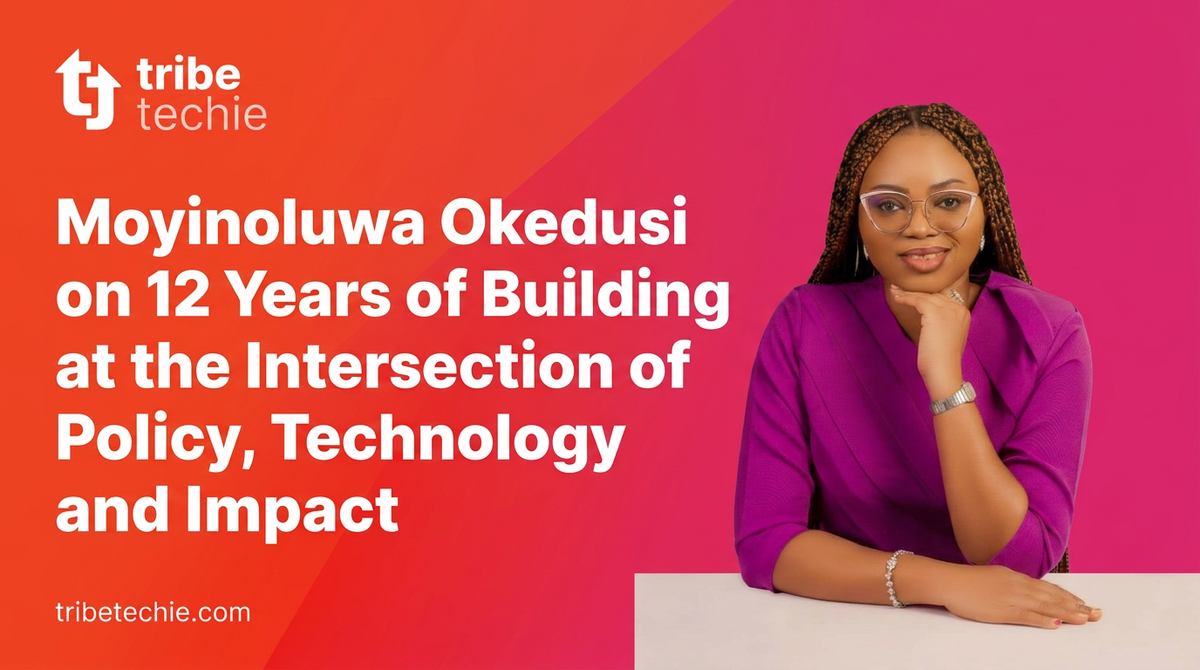
Moyinoluwa Okedusi has spent the last 12 years learning just how true that is. Her career has taken her from the Nigerian civil service to international development, innovation, technology and AI, with each role bringing a different set of problems to solve and a different set of things to learn.
When Tribe Techie sat down with her for a WorkLife conversation, it quickly became clear that the more interesting part of her story is not simply how much work she has done. It is how often she has found herself in a new space, learning something she did not know before, and what all of that work has taught her about the kind of career and life she wants.
Also Read: Workplace Culture: Nobody Said You Had to Do This
Her professional life has moved through the Nigerian civil service, migration and international development, innovation ecosystems, AI education and programme management. She has worked on labour policy, supported returned migrants and young people, led programmes reaching thousands of people, worked across Nigeria's innovation hub ecosystem, built an AI education organisation and now leads programme management at Co-creation HUB across several African markets.
There is a very simple reason she has taken that many turns.
“In a nutshell, my curiosity.”
She likes learning new things. She does not particularly enjoy staying in one place for too long. “I get bored quickly,” she says.
That has allowed her to move between sectors without treating each move as a complete reinvention. The subject changes, the people change, and the problems change, but she keeps picking up something from one room and carrying it into the next.
It has also meant a lot of work, and recently, she has become much more deliberate about what happens when the work is done.
A few months ago, Moyinoluwa would have answered “yes” without hesitation if asked whether her life revolved around work. A new role, a demanding pace and a growing list of responsibilities had pushed her “on the edge of burnout.”
Then she went to Zanzibar.
For six days, she snorkelled in the Indian Ocean, ate fresh fruit, visited tourist sites, read fiction and met new people. She did not try to turn the holiday into another productive exercise. She simply took the break.
“That trip was the reset I badly needed because I came back refreshed and revitalised.”
It is a small detail in a much bigger career story, but perhaps one of the most revealing.
Because Moyinoluwa's 12-year journey is not just about the jobs she has held or the programmes she has led. It is about leadership, ambition, the people who helped shape her, the mistakes she has had to unlearn and, increasingly, figuring out what a good life looks like when there is always something else that could be done.
And she has some strong opinions about what Africa should, and should not, be doing while we are at it.
It started with policy, writing and a manager who noticed something.
Moyinoluwa’s first job after her Master’s degree was not in technology or innovation. In 2013, she joined the Federal Ministry of Labour and Employment in Abuja, working in Occupational Health and Safety and supporting the development of labour and OSH policies and regulations designed to protect Nigerian workers. It was also where one of the first important pieces of her career fell into place.
Her manager, Mrs. Mojisola Sonubi, noticed that she could write. Moyinoluwa began doubling as her manager’s PA, attending meetings, writing minutes and memos and preparing speeches, including one for a Permanent Secretary. The writing eventually earned her wider recognition when she won third prize in the 2017 Federal Civil Service Week Essay Competition, becoming the first person from the Federal Ministry of Labour and Employment to win. She received the plaque and cash prize from the Head of the Civil Service at the State House Awards Dinner.
After four years in Abuja, she was posted to Lagos, where another opportunity came through Ms Mienye Badejo, who was leading the Migrant Resource Centre launched by the Ministry in partnership with the International Organization for Migration.
The centre was responding to the irregular migration crisis, particularly the dangerous journeys through Libya and the Mediterranean towards Europe. Moyinoluwa volunteered to join because she wanted to understand international development and project management beyond what she had encountered in the civil service. That decision kept opening doors.
For five years, she managed the GIZ Migration for Development programme, supporting more than 2,000 returned migrants and graduates across Lagos, Ogun, Oyo and Ondo through vocational and business training. She also led communications work with IOM, taking irregular migration campaigns to more than 1,000 secondary school students and young people in Lagos.
Then came another unexpected turn: innovation inside the civil service itself.
Moyinoluwa became a finalist in the Federal Civil Service Innovation Challenge for an internal whistle-blowing system. The challenge was implemented by MIT in 2020, and the system was eventually deployed by the Office of the Head of the Civil Service.
By this point, the pattern in her career was becoming difficult to miss. She kept moving towards new problems rather than simply climbing a predictable ladder.
She credits some of that movement to the women who managed her along the way, particularly Ms Nneka Ukay and Ms Grace Oluchi at Innovation Support Network, where she later became Programs and Partnerships Lead.
“I am a product of great women managers, and I am forever in their debt,” she says.
It is a line that says a lot about how she thinks about career development. For Moyinoluwa, good management was not simply about having someone approve leave requests or assign tasks. The women she worked with gave her room to develop skills she might not otherwise have discovered.
And she is quite happy to challenge the familiar stereotype that women are difficult managers. Her own career, she points out, has been shaped by women who stretched her.
From mapping innovation hubs to building AI programmes
In 2022, Moyinoluwa joined Innovation Support Network, where her work expanded considerably. She led a Ford Foundation-funded programme that empowered more than 15,000 women, young people and persons with disabilities across six states.
She also led a nationwide enumeration and mapping exercise covering more than 150 innovation hubs across 20 states. The data generated from that work helped inform conversations around national digital education, innovation and enterprise policies.
Eventually, she took over as Executive Secretary, managing a team and national operations, programme delivery, governance and multi-market budgeting across 168 innovation hubs in Nigeria.
The move into technology and innovation was not a rejection of her policy background. If anything, it gave her another way of applying what she had learnt.
That connection between policy and technology has remained central to how she sees the sector.
“A lot of people do not understand the importance of the right policies in shaping a sector or industry,” she says. “The right policies can create an enabling business environment, while the wrong policies can stifle development in the sector.”
The challenge, she explains, is that technology moves extremely quickly. She describes it as “like a moving train,” with governments and regulators often playing catch-up.
She points to the European Union’s GDPR as an example of a policy framework that shaped conversations far beyond Europe, including in Nigeria, and the EU AI Act, which became the first comprehensive legal framework specifically addressing AI.
Africa is still figuring out its own approach. Several countries are developing national AI strategies, while the Kigali Declaration has brought 49 African countries behind a broader commitment to responsible AI development.
Moyinoluwa’s own work in AI became more direct in 2023, when she became the founding Country Lead of Optimus Digital Future, an AI education nonprofit. She led the organisation’s setup, strategic programme design and donor and stakeholder engagement, while building initiatives that reached more than 100 media professionals, 15 early-stage ventures and 20 product leaders.
She also directed and presented a 13-episode educational broadcast campaign designed to make AI easier for a wider audience to understand.
Go deeper on GCC & Africa tech — $9.99/month.
Deep dives and investor insights the free digest doesn't cover.
But while she is clearly excited about AI, she is not interested in the breathless rush to attach the technology to every problem.
“First of all, people need to calm down with the AI slop,” she says, laughing.
Then she makes the point more seriously.
“Africa has fundamental issues that we cannot slap technology or AI on.”
For her, the excitement around AI cannot become an excuse to ignore the infrastructure underneath it. Developed countries have been able to benefit from technology partly because they went through years of industrialisation, building electricity systems, roads, manufacturing capacity and private-sector economies.
“Africa cannot skip this phase and expect to fully reap the benefits of technology and AI,” she says.
“We need to go back to the basics: building infrastructure that will power technology and AI across all sectors.”
It is a fairly grounded position for someone working in one of the most hyped areas of technology right now. Moyinoluwa is not dismissing AI; she is asking people to be more honest about the conditions required for it to work.
She became even more interested in the possibilities of AI after attending the Global Inclusivity and AI: Africa Conference in 2024, where she learnt about its potential contribution to achieving 12 of the Sustainable Development Goals.
But she believes the continent has to navigate the technology responsibly, particularly when questions about human dignity and the future of work are becoming harder to ignore.
The part of leadership she had to unlearn
As her responsibilities grew, Moyinoluwa discovered that one of her biggest challenges was not learning how to manage more work. It was learning that she did not have to do all of it herself.
“I’m a recovering perfectionist who would rather do a task myself than let someone else mess it up,” she says.
It is an honest admission, especially from someone whose career has increasingly involved leading teams and overseeing complex programmes. The problem with perfectionism becomes more obvious when you become responsible for other people: if you insist on doing everything yourself, you eventually become the person everyone has to wait for.
Moyinoluwa eventually recognised that if an organisation could not function whenever she stepped away, something was wrong.
“If everything stops because I am not present — and nobody is indispensable — then I am not delegating enough.”
So she began delegating more and allowing other people to take ownership. She also learnt what she describes as another important leadership lesson: “to lead by influence and not by force.”
There was a comment from a friend that helped put this into perspective. The friend told her that “people will go out of their way for you because they like you.”
That stayed with her.
Perhaps because there is a difference between having people comply because you are their boss and having people genuinely want to help you succeed. After years of managing programmes, teams and partnerships, she seems increasingly interested in the latter.
Then there is the question of what happens after work
For all the ambition and movement in her career, this may be the part of the conversation Moyinoluwa has thought about most recently: what does she actually want her life to look like when she is not working?
Four to six months earlier, she says, her answer to whether her life revolved around work would have been an emphatic yes.
The pace of technology and innovation does not exactly help. There are always multiple things competing for attention, and when she started her current role, adjusting to a new environment alongside its responsibilities pushed her “on the edge of burnout.”
Then came the Zanzibar trip.
The six-day break gave her enough distance to realise just how badly she needed to stop.
She has since become more intentional about leisure and hobbies. She is an introvert, so her ideal day off does not necessarily involve a packed itinerary. Give her a good fiction book, a cup of chamomile tea and some quiet, and she is perfectly happy.
When the social battery is charged, however, she enjoys karaoke with friends, travelling, visiting museums and historical sites and meeting people from different cultures.
She also started taking proper breaks more deliberately a year or two ago after recognising what happened when she did not.
“Work became life, and my mind suffered for it.”
Her last complete switch-off was the Zanzibar holiday, and she has already scheduled two more trips before the end of the year. There is even a new ambition competing with her professional ones.
“I have started thinking about how I can retire early and face my enjoyment life,” she says, laughing.
The idea came into sharper focus after she saw a TikTok post about being “ruthless with your work and relaxed with your life.” She realised that, since her vacation, she had started doing exactly that.
“When I’m working, I give my best; and when I’m resting, I completely tune out of work.”
Outside the office, she is building a different kind of routine. She attends a monthly book club, wants to explore a new location every quarter, either within or outside Nigeria, and is deliberately making room for things that feed her creativity, from stage plays and new music to creating more content and meeting people outside her professional circles.
It is a different way of looking at ambition. The career is still important. She is still learning, still building and still interested in what technology can do for Africa.
But there is now a little more room around all of that.
Perhaps that is what makes her “work no dey finish” line more interesting than it first sounds. It is not a complaint about having too much to do. It is an acknowledgement that the list will probably never be empty, so waiting for it to empty before you rest is a losing strategy.
There will always be another programme to deliver, another policy to understand, another team to lead, another technology to figure out and another problem that needs attention.
Moyinoluwa is still very much interested in all of it; she just does not intend to spend every waking hour proving it.
Engagement