
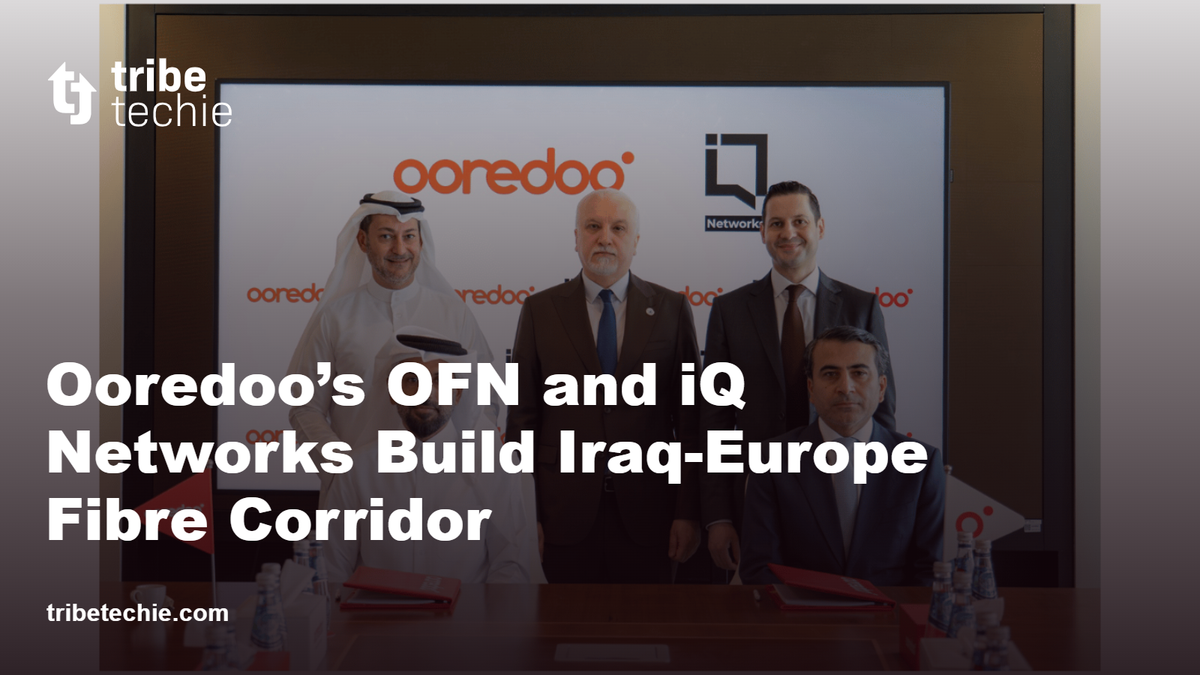
OFN and iQ Networks have agreed to use dark fibre across Iraq, establishing a new Iraq-Europe fibre corridor that extends Ooredoo’s FIG subsea cable route toward Türkiye and Europe. This strategic partnership aims to bridge digital infrastructure gaps between major global markets.
The agreement connects two separate pieces of Ooredoo’s connectivity strategy: FIG’s planned subsea landing in Iraq and iQ Networks’ terrestrial fibre network. Together, they are designed to create a high-capacity route linking Asia, the Gulf and Europe through Iraqi territory.
Also Read: Qatar Tech Startups Offered Up to $5.5M for Expansion
The companies have not disclosed the value of the fibre agreement or a completion date. Implementation remains subject to regulatory, government and other required approvals.
Expanding the Iraq-Europe Fibre Corridor
The new agreement addresses what happens after FIG reaches Iraq. The Fibre in Gulf (FIG) system will carry high-capacity traffic by sea into Iraq, while the dark fibre secured from iQ Networks will provide the overland connection from Iraq toward Türkiye and Europe.
That creates an alternative international route for traffic moving between the Gulf, Asia and European markets. It gives wholesale customers another path rather than relying on existing corridors.
FIG is being developed with 24 fibre pairs and up to 720 Tbps of capacity, connecting Qatar, Oman, the UAE, Bahrain, Saudi Arabia, Kuwait and Iraq. Ooredoo describes it as the largest subsea cable system ever built in the GCC.
Strategic Benefits for Operators
Dark fibre gives OFN dedicated fibre capacity that can be lit and managed according to customer requirements. That is particularly useful for operators with large and predictable bandwidth needs, including hyperscalers, cloud providers, data centres, AI companies, content platforms and telecom operators.
Go deeper on GCC & Africa tech — $9.99/month.
Deep dives and investor insights the free digest doesn't cover.
For these customers, the proposed Iraq route offers another geographic option between the Gulf and Europe while increasing overall route diversity. For Iraq, the project is also about turning its geography into an infrastructure advantage.
The country sits between the Gulf and Türkiye, creating a natural overland path between major connectivity markets. Adding high-capacity fibre to the planned FIG landing could allow more international traffic to pass through Iraq and strengthen its position as a regional transit hub.
Future Growth and Connectivity
Asoz Rashid, group CEO of iQ Group, said the combination of Iraq’s location, iQ’s terrestrial network and FIG’s subsea capacity could establish a major route between Asia, the Gulf and Europe. The deal comes as demand for international bandwidth rises alongside AI, cloud computing and data-centre growth.
AI workloads increasingly require large volumes of data to move between data centres, cloud platforms and regional computing hubs. More fibre routes can provide additional capacity and reduce dependence on individual connectivity paths. That makes route diversity increasingly important for operators that need resilient international networks.
Khalid Hassan Al-Hammadi, CEO of OFN, said the agreement is the next stage of its infrastructure programme, combining FIG’s subsea capacity with iQ Networks’ terrestrial infrastructure.
Why it Matters to the Region
The agreement moves Ooredoo’s FIG project closer to becoming more than a Gulf cable system. By connecting its planned Iraqi landing to terrestrial fibre toward Türkiye and Europe, OFN is building a route that could extend the cable’s reach well beyond the Gulf.
For Iraq, the opportunity is to capture more value from international data traffic crossing its territory. For Gulf and European connectivity markets, it adds another potential route between two major digital regions. The next milestone will be the completion and activation of the connected subsea and terrestrial segments, turning the planned corridor into a working international transit route.
Engagement