Exabeam introduces its on-premises LogRhythm SIEM platform in Iraq, helping organisations monitor enterprise AI activity and investigate cyber threats.
The company has introduced its modernised LogRhythm Security Information and Event Management (SIEM) platform to the Iraqi market, bringing AI-assisted security operations to organisations in government, financial services, energy, telecommunications and critical infrastructure.
Also Read: du and ZTE Launch Upper 6GHz Technology in UAE
The platform allows security teams to monitor enterprise use of ChatGPT, Google Gemini and GitHub Copilot, while using locally hosted AI models to investigate suspicious activity, query security data and prioritise alerts.
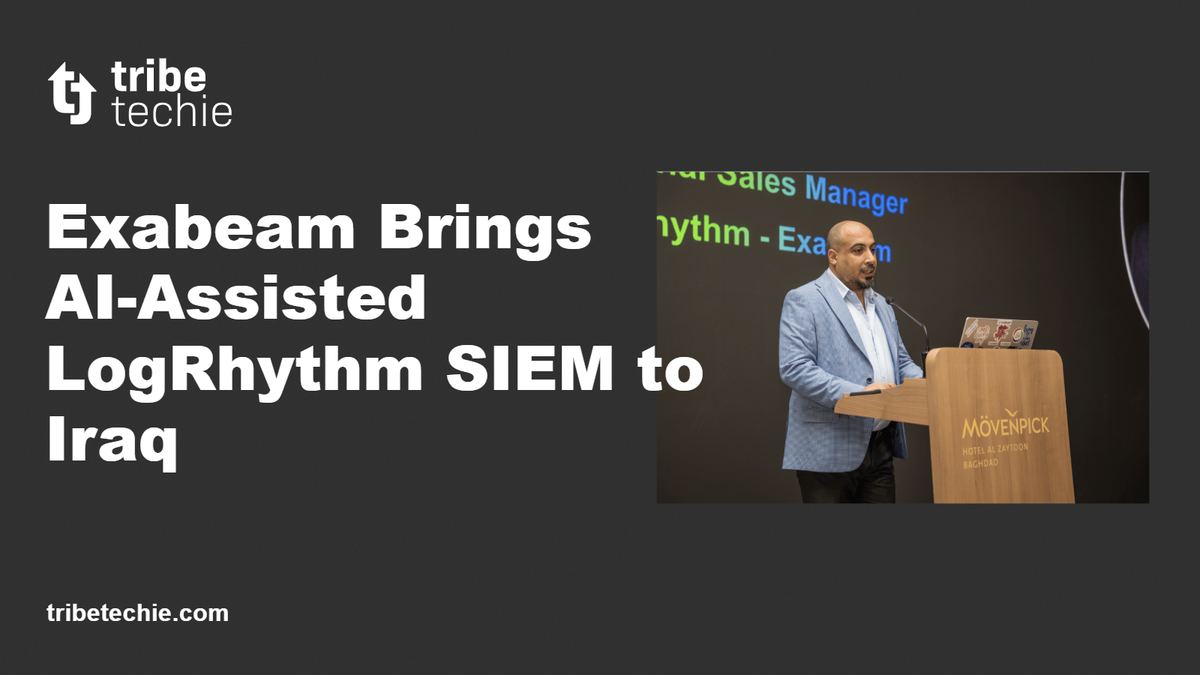
Exabeam announced the Iraq launch on November 2 during its customer and partner events in Baghdad, held under the theme "Securing Iraq's Digital Future." The introduction targets organisations that want to adopt AI-assisted cybersecurity without giving up control of where their sensitive security information is processed.
Capabilities of LogRhythm SIEM
One of the platform's key capabilities is collecting enterprise AI activity data. LogRhythm SIEM includes prebuilt data collectors for ChatGPT, Google Gemini and GitHub Copilot. These integrations bring activity from the AI applications into the organisation's security monitoring environment for logging, risk tracking and investigation.
This addresses a growing challenge for businesses: understanding how employees interact with AI tools and whether those interactions introduce security risks. For example, an employee could unintentionally expose sensitive company information while using an external AI assistant. Similarly, an AI-enabled application with access to internal systems could create additional security risks if its permissions are misused.
By collecting AI-related activity alongside other security information, the platform gives analysts more context when investigating suspicious behaviour and potential insider threats. The objective is to extend security monitoring beyond traditional employees and devices to include AI applications and other non-human users of enterprise systems.
Leveraging Local AI and Data Control
Another important feature is the platform's Model Context Protocol (MCP) server. MCP lets AI applications connect with external tools and information sources. In the solution, the server connects locally hosted generative AI models with security data, allowing analysts to query, investigate incidents, and triage alerts within their organisation's own infrastructure.
Go deeper on GCC & Africa tech — $9.99/month.
Deep dives and investor insights the free digest doesn't cover.
This is particularly relevant to Iraqi organisations that handle sensitive government, financial or infrastructure data. These entities often have strict requirements about where that information is stored and processed. Instead of relying on an externally hosted AI model to analyse security information, organisations can use local models to assist with investigations while retaining control of their SIEM data.
The platform also includes a self-service reporting engine that allows security teams to customise and schedule compliance reports. This can help organisations document their security activities and prepare reporting for regulatory and internal requirements. Importantly, AI assists analysts with investigations and alert prioritisation; human security professionals remain responsible for evaluating findings and deciding how to respond.
Cybersecurity in the Iraqi Market
Iraq's expansion of digital payments, online public services and connected energy infrastructure is creating more complex environments for cybersecurity teams to protect. Banks must secure digital transactions and customer information. Government agencies need to protect public-service platforms and sensitive records, while energy and telecommunications operators manage systems that support essential services.
As these environments become more connected, security teams must monitor more users, devices, applications and data flows. Exabeam's on-premises approach gives organisations another option for adopting AI-assisted security operations, particularly where cloud deployment may not align with their infrastructure, compliance or data sovereignty requirements.
The company is also positioning the platform for sector-specific security operations centres (SOCs). These centres bring together security personnel and monitoring technologies to detect, investigate and respond to cyber threats. During its Baghdad events, Exabeam demonstrated the platform's AI capabilities and discussed developing sector-specific SOCs. It also introduced partner programmes and incentives to expand its cybersecurity business in Iraq.
Future Outlook and Strategic Implementation
The Iraq introduction forms part of Exabeam's wider effort to make AI-assisted security operations available across different infrastructure environments. Organisations can choose between its cloud-native New-Scale Security Operations Platform and the self-hosted platform, depending on their operational and data requirements.
These developments reflect a broader change in enterprise cybersecurity. As companies introduce AI assistants and automated agents into their operations, security teams need greater visibility into how those systems access information and interact with business applications. Monitoring AI activity is becoming another part of protecting corporate networks, alongside traditional user behaviour, devices and applications.
The next stage will depend on adoption across regulated sectors, the availability of local implementation partners and how effectively organisations integrate the platform with their existing security systems. For banks, government agencies and critical infrastructure operators, the main value proposition is the ability to use AI to support security investigations while maintaining control over sensitive data.
Engagement