
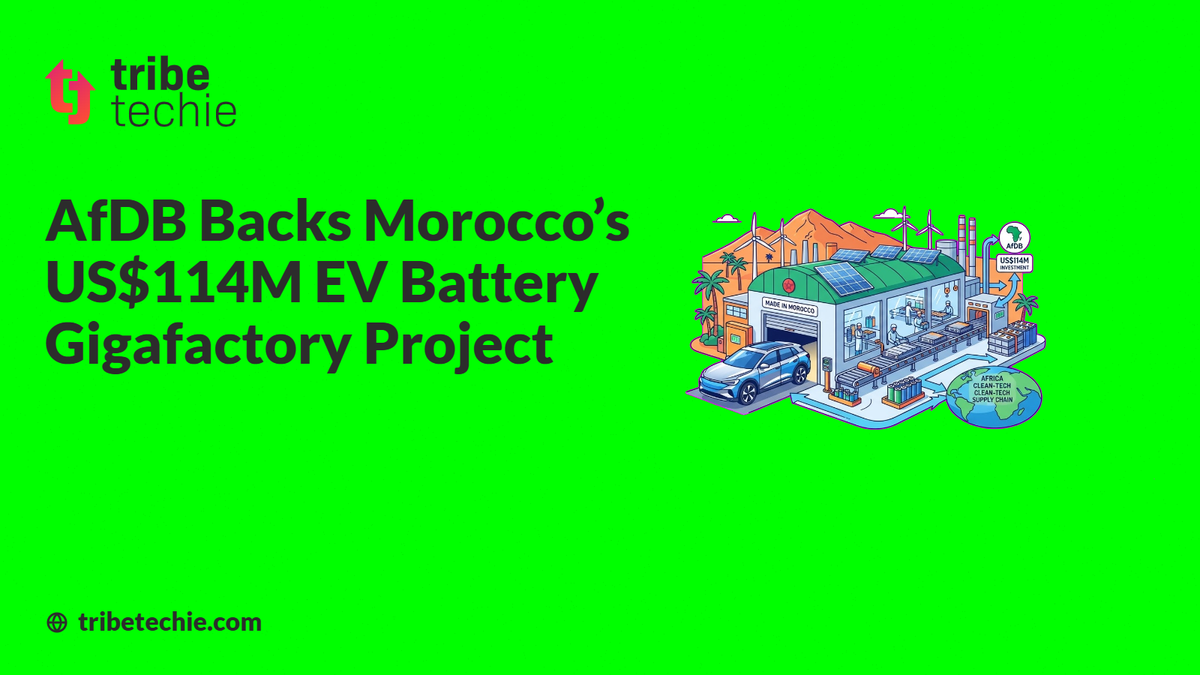
The AfDB has approved US$114 million for Morocco’s EV battery gigafactory, strengthening Africa’s clean-tech manufacturing and electric vehicle supply chain.
The financing will support Gotion Power Morocco, a subsidiary of China's Gotion High-Tech, in developing an integrated battery manufacturing facility within the Rabat-Salé-Kénitra Free Trade Zone. The project marks one of the largest investments in Africa's emerging battery manufacturing industry and represents a significant step towards localising electric vehicle production on the continent.
Beyond the direct financing, the AfDB also plans to mobilise up to an additional US$160 million (€141 million) from development finance institutions and other partners to support the project.
While Africa possesses many of the critical minerals required for battery production, including lithium, cobalt, manganese and graphite, much of the value-added processing and manufacturing still takes place outside the continent.
The new gigafactory seeks to change that by establishing large-scale battery production within Africa, allowing Morocco to move beyond vehicle assembly into higher-value manufacturing.
The facility will produce lithium iron phosphate (LFP) battery cells and battery packs, a battery chemistry increasingly favoured for electric vehicles because of its lower cost, improved safety and longer lifespan.
Production will initially reach 10 gigawatt-hours (GWh) annually, supplying batteries for electric vehicles serving both domestic and international markets. Gotion High-Tech ultimately plans to expand the facility's production capacity to 100 GWh, positioning it among the largest battery manufacturing plants in the region.
According to the African Development Bank, the factory will operate primarily on renewable energy, aligning with Morocco's broader clean energy strategy and supporting lower-carbon industrial production.
The project complements Morocco's significant investments in solar and wind power, reinforcing the country's strategy of combining renewable energy generation with advanced industrial manufacturing.
Kevin Kariuki, AfDB Vice President for Power, Energy, Climate and Green Growth, described battery storage as a critical component of Africa's clean energy transition.
Go deeper on GCC & Africa tech — $9.99/month.
Deep dives and investor insights the free digest doesn't cover.
He noted that facilities of this scale will help strengthen the integration of renewable energy into electricity grids while supporting the continent's broader decarbonisation objectives.
The project is expected to create more than 600 direct jobs during its first phase while achieving a 70% local industrial integration rate, reflecting efforts to build a domestic battery manufacturing ecosystem.
Over the past decade, Morocco has emerged as one of Africa's leading automotive manufacturing centres, attracting major global automakers through competitive production costs, modern industrial infrastructure, free trade agreements, and proximity to European markets.
The battery gigafactory represents the next stage of that industrial strategy by enabling Morocco to manufacture one of the most valuable components in the electric vehicle value chain domestically.
The investment also reflects growing efforts to ensure Africa captures greater value from its abundant natural resources. Historically, the continent has exported critical minerals for processing abroad before importing higher-value manufactured products.
Developing domestic battery manufacturing capacity offers an opportunity to retain more economic value locally while supporting industrialisation, skills development, technology transfer, and export growth.
The project aligns with broader continental ambitions to build regional electric vehicle supply chains capable of supporting Africa's transition towards cleaner transportation and renewable energy systems.
Construction will initially focus on delivering the first 10 GWh production phase before subsequent expansion toward the planned 100 GWh capacity.
If the expansion proceeds as planned, the Gotion gigafactory could position Morocco as one of Africa's largest battery manufacturing centres and strengthen the continent's role in the global electric mobility and clean energy value chain.
Engagement